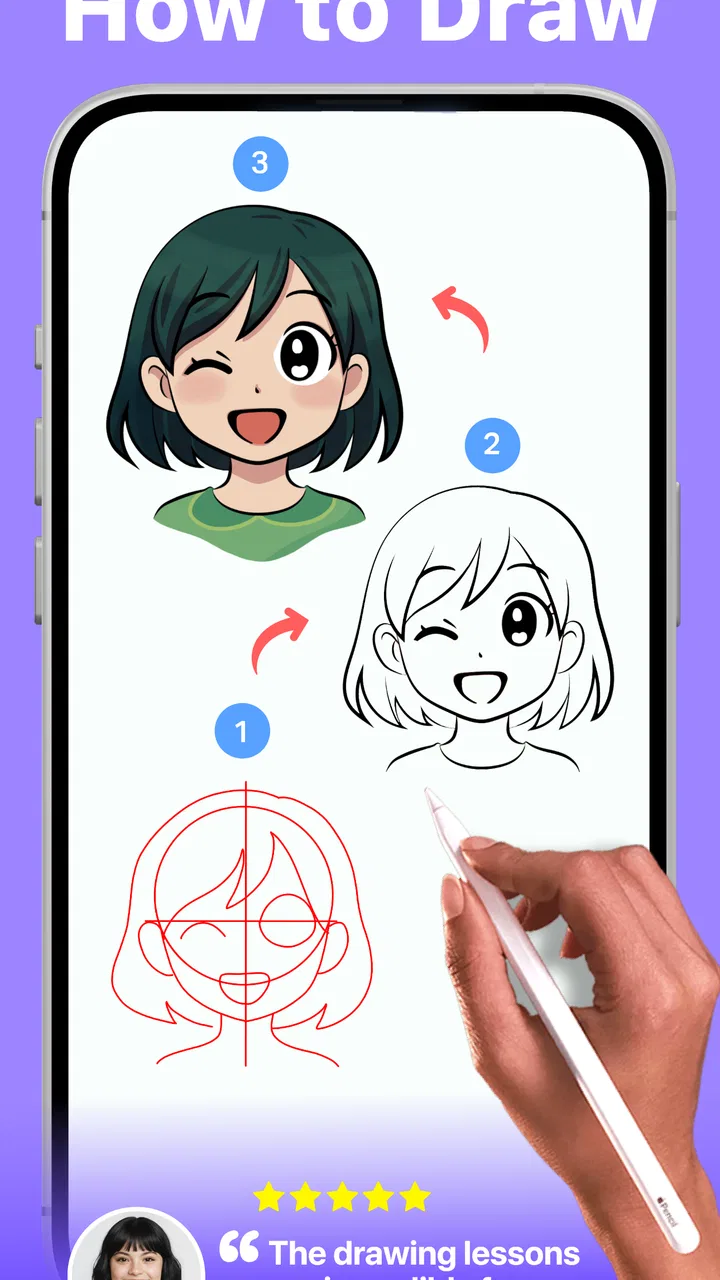
Drawing Desk: Learn to Draw
- 4.5
- Rating
- 10.00M
- Installs
- Free
- Price

 Analysis by App-foxy
I found Drawing Desk: Learn to Draw most useful when a creative app needs to serve more than one person in the same home. It is an art and design app from 4Axis Technologies, and its focus is practical rather than social: open a lesson, follow the example, sketch, paint, and gradually build confidence. I used it as a casual drawing space, but its lesson-based approach also makes it easier to hand a phone or tablet to a child, a beginner, or someone who simply wants a quiet activity away from video apps.
The app is free to download and suitable for Everyone, which immediately makes it approachable for a shared device. Its average rating is 4.4 from more than 133 thousand ratings, and it has passed 10 million installs. Those figures suggest a well-established audience, but they do not replace personal fit. I would recommend it most strongly to beginners who want direction. Someone looking for a professional illustration workstation, advanced layer management, or a completely open-ended digital canvas may feel restricted.
How Drawing Desk works in a shared household
When I use Drawing Desk in a shared household, I find it works best when everyone treats the device as a turn-taking sketchbook rather than a communal workspace. A simple handoff routine—finish a natural stopping point, then let the next person begin their own exercise—keeps creative time relaxed and reduces mix-ups. It also makes room for a useful next question: how can a family make the lessons feel shared without turning drawing into a competition?
You May Also Like

 Blood Strike: 2.5 Anniversary
Blood Strike’s Loadouts Turn Every Drop Into a Tactical Gamble
A close look at Blood Strike’s custom loadouts: how fast access to signature weapons reshapes its battle royale rhythm, rewards preparation, and narrows the gap between fights.

 Pandora - Music & Podcasts
Pandora’s Music Is Easy to Start, but Harder to Recover
Pandora’s strength is its low-effort path from a seed to a station. Its weak spot is how much confidence it asks you to place in connection, setup, and quiet recovery.

 8 Ball Pool
 Is Built on Rivalries, Rematches, and Routine
A close look at the rivalries, rematches, shared routines, and unanswered safety questions that turn a quick pool match into a persistent mobile community.

 Samsung Music
’s Quiet Strength Is Playing What You Already Own
Its reach comes less from spectacle than from dependable access to a personal library. That simplicity is both the app’s strongest retention engine and its ceiling.

 AccuWeather: Weather Radar
AccuWeather Review: A Quick, Clear Forecast for Everyday Decisions
For everyday plans, the best forecast is the one you can understand quickly. AccuWeather makes rain timing, radar, and local conditions easy to act on, with a few trade-offs.

 Hill Climb Racing
Why Hill Climb Racing Still Turns Crashes Into One More Run
A tiny car, a bumpy hill and one more upgrade: Hill Climb Racing keeps resurfacing because its simple chaos makes every near-miss feel personal.
More From Our News Desk
View All News


A practical activity for a family tablet
A realistic use case is a tablet left on a kitchen table or in a living room. One person can work through a drawing exercise while another watches, then the device can be passed along for a different sketch. That arrangement suits the app better than a competitive game because the main result is the drawing itself. There is no pressure to keep up with another player, and a beginner can stop after a short practice session without losing the value of the activity.
I especially like this format for an adult and child working side by side. The adult can demonstrate a line or shape, while the child repeats it in the lesson. The app gives the session a starting point, so nobody has to invent an activity from an empty canvas. It also leaves room for personal choices: two people can follow the same general exercise and still produce noticeably different results.
That said, a shared device is not the same as a shared workspace. I would not treat it as a dependable family gallery or a place where several people can safely organize long-term portfolios. The sensible approach is to decide who is using it before starting, save or export important work when appropriate, and avoid assuming that one person’s drawing area is designed for multiple profiles.
What a first session feels like
The central appeal is the collection of drawing and painting lessons. The app presents itself as a large practice library, with over 800 lessons available as the main learning promise. That breadth is useful because a child may want simple objects, while an adult beginner may prefer more deliberate sketching or painting practice. I would browse first rather than open the first lesson blindly; choosing a subject that feels achievable makes the opening session less frustrating.
For a new user, I suggest treating the first few exercises as hand control practice rather than finished-art tests. Use a stylus if the device supports one, but do not assume that a basic finger drawing is a failure. The early value comes from learning how the canvas responds, how much pressure or speed feels comfortable, and how to correct a line without abandoning the whole picture.
One non-obvious strength is that the lessons can act as a decision filter. Instead of spending ten minutes wondering what to draw, I can choose a guided subject and begin immediately. This matters on a shared device, where a short window of free time may be the only opportunity available. The trade-off is that guided practice can feel repetitive to someone who already knows exactly what they want to create.
Keeping personal boundaries clear
Before giving the device to another household member, I would establish a simple routine: finish the current exercise, identify the drawing, and leave the canvas in a recognizable state. This is not a substitute for separate accounts or dedicated profiles, but it prevents the most common shared-device confusion. A child’s unfinished sketch should not be mistaken for an adult’s work, and an adult should not overwrite a practice page that someone else is still using.
I would also avoid storing sensitive information in the artwork or using the app as a place for private notes. The Everyone age classification makes it comfortable for general household use, but an age label is not a promise that every family member will use the same settings or understand every purchase prompt. A parent should remain nearby when a younger child is exploring the app, especially if the device is connected to a payment method.
The current version is 10.3.2 and the minimum operating system is Android 6.0. That makes the app available on many older Android devices, which is helpful if the family tablet is not new. Still, older hardware may make drawing feel less comfortable than on a recent tablet, particularly when the canvas is large or the screen is small. I would test the basic drawing response before planning long sessions around an older phone.
Coordinating lessons without turning art into homework
When several people use the app, coordination works best with a light structure. A family could choose one lesson theme for the afternoon, let each person interpret it, and compare the results afterward. The point is not to rank the drawings. It is a simple way to make the lesson library feel shared while preserving individual control over color, line quality, and detail.
Another useful workflow is to divide the session into demonstration and independent practice. One person follows the lesson slowly while the others watch, then everyone tries the same idea separately. This exposes a limitation as well as a benefit: the app can guide the activity, but it cannot replace a patient teacher who notices why a particular line or proportion is difficult.
For siblings or roommates, I would use a short handoff rule. The current user should finish a natural step rather than pass the device in the middle of a delicate detail. If the app is being used on a phone, this matters even more because the smaller screen encourages quick sessions and makes accidental touches easier. A tablet is generally the better shared canvas, while a phone is more convenient for private practice on the go.
There is also a useful distinction between learning together and editing together. I would recommend the first, but I would be cautious about expecting several people to work on one piece at once. Without inventing a collaboration system that may not exist, the reliable household plan is sequential: one person draws, then another begins a separate exercise or receives the device after the first person is finished.
Age, trust, and purchase awareness
The Everyone rating makes the app a reasonable candidate for a family device, especially when the goal is drawing rather than open-ended browsing. Younger users can start with simple lessons, and adults can use the same installation for more patient practice. I would still judge readiness by the child, not only by the label. A child who can follow a lesson and ask before tapping a purchase option is a better fit than one who tends to press every visible button.
The app includes in-app purchases ranging from $0.99 to $99.99 per item. That is the most important household consideration. The download itself is free, but a parent should explain that free access and optional paid content are different things. On a shared device, I would review the device’s purchase protections before handing it over, and I would make the rule clear: ask first, even if a button appears to unlock a useful lesson or tool.
This is also where trust matters more than convenience. A child may understand that the app is for drawing but not realize that a purchase can affect the household account. An adult using the same device may assume that a payment setting is already protected. A quick conversation before the first session prevents an awkward surprise and keeps the app associated with creativity rather than an accidental charge.
For older children and teenagers, the app can be a gentle entry point into digital art. I would not present it as a complete art education, though. It is better for building a habit, practicing observation, and learning to make marks on a screen than for replacing structured instruction in anatomy, perspective, color theory, or professional software. If a young artist is already working seriously, a more advanced drawing program may offer better control and organization.
Where it beats ordinary alternatives
Compared with a blank canvas app, Drawing Desk removes the hardest first decision: what should I draw? That makes it more welcoming for a beginner who opens an art app, stares at an empty page, and closes it again. Compared with watching drawing videos, the lesson-centered format encourages the user to make marks immediately rather than passively observe. The difference is small in theory but significant in practice; active repetition is what makes a short session useful.
Compared with a professional illustration tool, it is less intimidating but also less suitable for complex projects. A professional app is the better choice when I need precise layer control, detailed file management, or a workflow built around finished client work. Drawing Desk is the better choice when I want a guided exercise, a low-pressure creative break, or an accessible activity for someone who has never used digital art software.
It also has a different role from a coloring-only app. Coloring can be relaxing, but it usually begins with an existing outline. Here, the more valuable challenge is creating the outline and developing the image. That requires more effort and may frustrate a user who only wants a calming fill-in activity. For that person, a simpler coloring experience would probably be a better fit.
Small details that improve the experience
My first practical tip is to choose lessons by difficulty and available time, not just by subject. A visually appealing exercise may require more patience than expected. On a shared device, a short, achievable lesson keeps the handoff smooth and gives a younger user a clear sense of completion.
My second tip is to use the app as a warm-up before free drawing. Spend a few minutes copying a guided shape, then create a variation without following the example exactly. This turns the lesson library into a source of ideas rather than a set of pages to reproduce perfectly. It also helps users who become discouraged when their result does not resemble the example.
My third tip concerns screen ergonomics. A phone works for quick practice, but a larger tablet is more comfortable for household sessions because the person drawing can see the reference and the canvas without constantly zooming or repositioning. If several people are watching, place the device on a stable surface rather than passing it around during the exercise.
A fourth useful habit is to separate experimentation from preservation. Try colors and marks freely while learning, but if a drawing matters, pause and make sure it is kept in the way the device and app allow. I would not rely on memory to reconstruct a favorite sketch later. This is particularly important when one device is shared and the next user may begin a different lesson.
Who should choose it, and who should skip it
I think the app is a strong match for a beginner who wants guidance without committing to a formal course. It also suits households that want a quiet, screen-based creative activity, adults returning to drawing after a long break, and children who enjoy learning by copying visible examples. The free entry point makes it easy to test the basic experience before deciding whether optional purchases are worthwhile.
I would skip it if my priority were professional production, advanced file organization, or a completely customized brush-and-layer workflow. I would also look elsewhere if I wanted robust collaboration between separate users, because a shared installation should not be confused with a fully managed family workspace. Users who dislike guided exercises may find the lesson structure more restrictive than helpful.
Another possible mismatch is someone seeking instant polished results. Drawing lessons still require patience, and the app cannot make proportions, lines, or color choices correct automatically. Its value increases when I accept imperfect sketches as part of practice. If that sounds like work rather than relaxation, a simpler creative app may provide a better evening activity.
My household verdict
After using it as both a personal sketching tool and a possible shared-device activity, I see Drawing Desk as an accessible starting point rather than an all-purpose art studio. Its strongest quality is the combination of a broad lesson library and a low-pressure format. I can give it to a beginner with a clear first step, then return to it myself when I want practice without planning a project from scratch.
The household experience depends on sensible boundaries. Decide who is using the device, protect purchases, avoid assuming that one canvas is a multi-user workspace, and save important work deliberately. Those small habits matter because the app is easy to share physically, even when personal work and account activity should remain separate.
For a family looking for a creative activity that works across ages, I would recommend trying the free version first. For a serious digital artist, I would treat it as a supplementary sketching and learning tool, not a replacement for a professional alternative. My final recommendation is simple: choose it for guided practice and approachable shared use, but keep expectations realistic about advanced control, collaboration, and paid extras.
FAQs for Drawing Desk: Learn to Draw
01What features does Drawing Desk: Learn to Draw offer?
Drawing Desk: Learn to Draw offers a wide range of features including a comprehensive set of drawing tools, layers, and tutorials. Users can explore various brushes, colors, and textures to enhance their creativity. The app also provides a community platform where artists can share their work and get feedback.
02Is Drawing Desk suitable for beginners in digital art?
Yes, Drawing Desk is perfect for beginners. It provides step-by-step tutorials and guided lessons to help newcomers learn the basics of drawing. The intuitive interface and easy-to-use tools make it accessible for users with no prior experience in digital art.
03Can I use Drawing Desk on both Android and iOS devices?
Absolutely! Drawing Desk: Learn to Draw is available for both Android and iOS platforms. Users can download the app from the Google Play Store or Apple App Store and enjoy seamless functionality across different devices, ensuring a consistent experience whether on a smartphone or tablet.
04Does Drawing Desk offer any in-app purchases?
Yes, Drawing Desk includes in-app purchases. While the app is free to download, certain advanced features and tools require a subscription or one-time purchase. Users can choose to enhance their drawing experience by unlocking premium content, but the basic version remains fully functional.
05How does Drawing Desk support collaborative work?
Drawing Desk supports collaboration by allowing users to share their artwork within the app’s community. Artists can invite friends to view, comment, and collaborate on projects. This fosters a sense of community and enables users to gain insights and improve their skills through shared feedback.
Pros
- User-friendly interface for beginners
- Wide variety of brushes and tools
- Offline mode available
- Supports high-resolution exports
- Regular updates with new features
Cons
- Some features require in-app purchases
- Limited layer functionality
- Occasional app crashes reported
- Ads can be intrusive at times
- Lacks advanced features for pros

Drawing Desk: Learn to Draw
Gallery